
Email Tracking Pixels: What an Open Really Proves
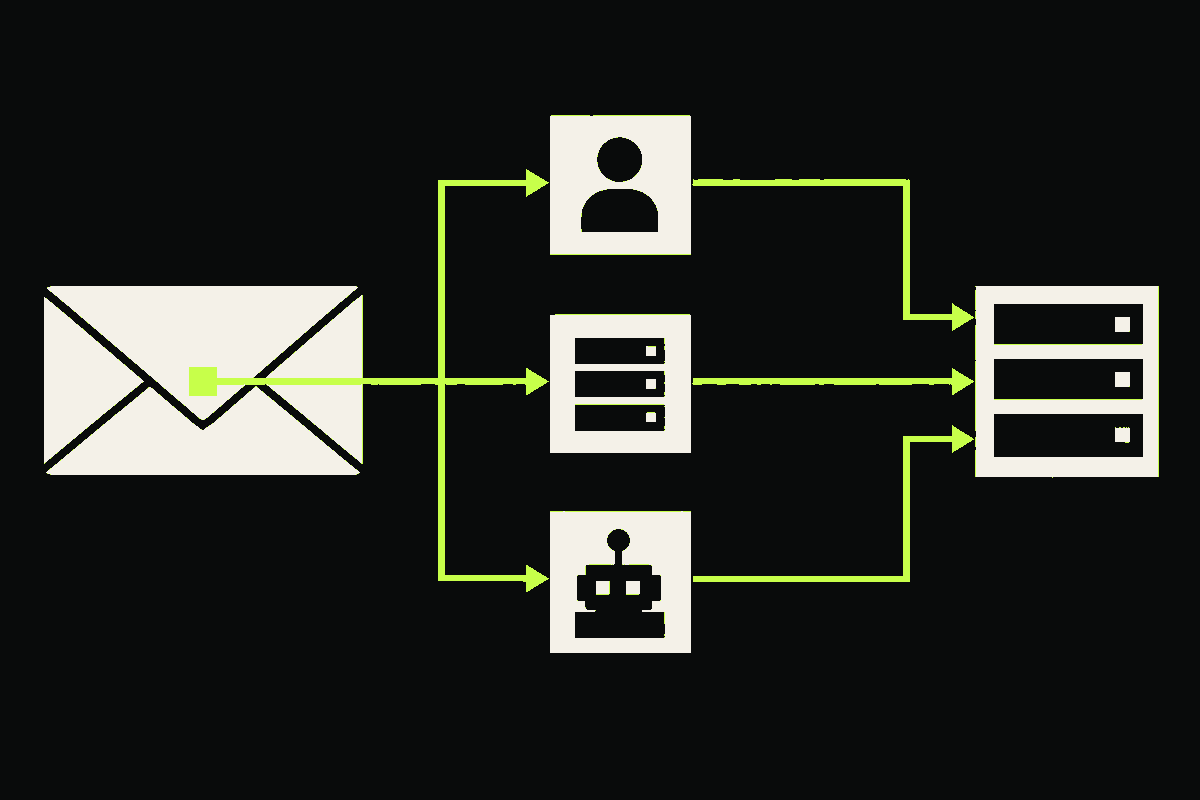
An email tracking pixel proves one thing: someone or something requested a remote image URL. It does not prove that a person opened the message, saw it on screen, read it, or cared about it.
I would store that request as remote_content_fetched, not email_opened. That name keeps the evidence honest when Apple Mail fetches images in the background, Gmail changes what the sender can observe, a security product inspects the message, a cache reuses an earlier response, or the recipient blocks images completely.
The server saw an HTTP request
A tracking pixel is usually a tiny remote image in the HTML part of a message. Its URL carries an opaque identifier for the send or recipient. When a mail client or intermediary requests that URL, the image server can record a timestamp and the request metadata it receives.
<img
  src="https://events.example/o/7f3c8a2d.gif"
  width="1"
  height="1"
  alt=""
>
The example is hypothetical. The 7f3c8a2d value should be a random, opaque token, not an email address, user ID, or other personal data exposed in the URL. The server can map that token to a message internally.
The request is an HTTP GET. RFC 9110 defines GET as retrieving a representation of the target resource. The protocol does not add a “human read this email” assertion. That interpretation comes later, inside the sender’s analytics system.
One fetch can come from several paths
As of October 7, 2026, Apple says that Protect Mail Activity downloads remote content in the background by default, regardless of whether the recipient engages with the message. Apple also routes those downloads through two relays so the destination does not receive the recipient’s IP address. A pixel request from that path is deliberately separated from the act of reading. The behavior is documented in Apple’s current Mail Privacy Protection notice.
Gmail’s current behavior creates a different boundary. Google says images display automatically by default unless Gmail considers the sender or message suspicious. Its image-loading documentation says image loading cannot reveal information about the recipient’s computer or location, or set and read browser cookies, although senders may sometimes know that an image-bearing message was opened.
HTTP caching adds another reason not to equate requests with views. RFC 9111 explains that caches store responses so later equivalent requests can reuse them. A sender might receive one request for several later renderings, or a request before the message appears on screen. At the other extreme, a reader can see the text while remote images remain blocked, producing no pixel request at all.
Security scanners create a second kind of automation. M3AAWG’s study of nonhuman interactions found that automated activity affects open and click metrics, and that scanners intentionally make exact detection difficult. Trying to classify every request as “human” or “bot” simply moves uncertainty into a new boolean.
Store the observation before deriving engagement
My rule is to keep independent facts instead of one engagement flag. A remote image fetch stays separate from a link request, reply, conversion, unsubscribe, and complaint. The facts can support different product decisions without one weak event overwriting a stronger one.
function reduceEngagement(events) {
  const facts = {
    remoteContentFetched: false,
    linkRequested: false,
    replyReceived: false,
    conversionCompleted: false,
    complaintReceived: false
  }

  for (const event of events) {
    if (event in facts) facts[event] = true
  }

  let interpretation = 'no_observed_interaction'
  if (facts.remoteContentFetched) interpretation = 'remote_content_only'
  if (facts.linkRequested) interpretation = 'link_request_observed'
  if (facts.replyReceived || facts.conversionCompleted) {
    interpretation = 'human_action_confirmed'
  }

  return { ...facts, interpretation }
}
The six-case fixture for this guide covered images blocked, a background fetch, a scanner-style fetch plus link request, a reply, an authenticated conversion, and a complaint after a fetch. All six preserved the expected state. Most importantly, the complaint remained an independent negative fact instead of being cancelled by a previous pixel load.
A link request is still only a request. Security systems can inspect links before a person clicks them, which is why the email link scanner guide puts account-changing actions behind a human-confirmed POST. For analytics, keep link_requested weaker than an authenticated conversion or an actual reply.
Which decisions need stronger evidence?
A pixel load should never confirm an account, prove inbox ownership, redeem a one-time token, subscribe someone to a list, or authorize access. It also should not be the only reason to keep an inactive address forever. Apple’s background fetch creates false positives, while blocked images create false negatives.
The same boundary applies to automation. Sending an aggressive follow-up seconds after a pixel request can react to a relay or scanner, not a reader. M3AAWG specifically warns that automated opens and clicks can trigger follow-ups the intended recipient did not request.
Complaints and unsubscribes deserve their own durable paths. An aggregate pixel metric cannot erase either one. The feedback loop guide separates recipient-level complaint reports from aggregate signals, and the suppression-list model keeps those events ahead of later verification or engagement evidence.
Is open rate still useful?
The strongest objection is fair: teams still use open rate to compare subject lines and spot campaign changes. I would not delete the metric. I would rename the underlying event and narrow the claim.
At an aggregate level, remote-content fetch rate can be a directional signal when the audience, mailbox-provider mix, image settings, and sending conditions are comparable. It is not a clean measurement of readers. A campaign can gain more background fetches without gaining attention, or lose tracked fetches while real readers consume the text with images off.
Use downstream evidence for decisions that matter: authenticated conversions, purchases, replies, completed forms, and product activity. Treat clicks as stronger than pixels but still scanner-prone. Keep unsubscribes and complaints as explicit negative signals. When the goal is inbox placement, use provider delivery and reputation evidence instead of assuming an open proves delivery to the inbox.
My default reporting label is remote content fetched. A dashboard may still show “opens” for familiarity, but the data model and documentation should state exactly what was observed. That small naming choice stops a network request from quietly becoming a claim about a person.