
From vs Reply-To vs Return-Path: Which Address Does What?
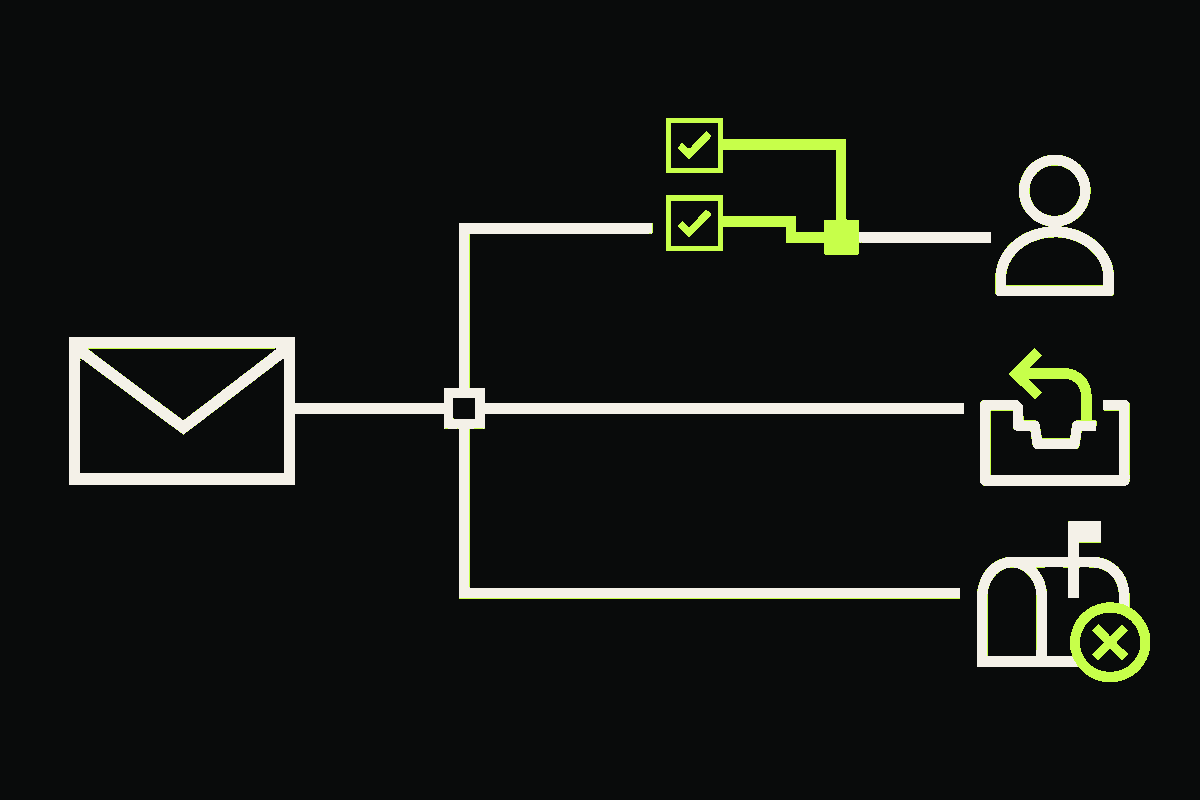
From names the message author, Reply-To suggests where a reply should go, and Return-Path records the SMTP reverse path used for delivery errors. They can be different without anything being broken.
The confusion starts because an email has both message headers and an SMTP envelope. Most inboxes show only one of those identities. When I need to understand a delivery or authentication result, I read the whole route.
Start with one message, seen at two stages
This is a hypothetical message. The first two lines are SMTP commands seen during transport. The remaining lines are from the message after final delivery, so they do not all exist together at the sender.
MAIL FROM:<bounces+42@bounce.example.com>
RCPT TO:<ana@example.net>

From: Billing <billing@example.com>
Reply-To: Support <help@example.com>
Return-Path: <bounces+42@bounce.example.com>
DKIM-Signature: v=1; d=example.com; s=mail; ...
Authentication-Results: mx.example.net;
  spf=pass smtp.mailfrom=bounce.example.com;
  dkim=pass header.d=example.com;
  dmarc=pass header.from=example.com
There are four jobs hiding in that trace:
From: billing@example.comidentifies the author shown to the recipient.Reply-To: help@example.comasks the mail client to address a reply to support.MAIL FROMsupplies the reverse path for delivery errors. After final delivery, the receiving server preserves that value inReturn-Path.- The authentication results say which domains SPF and DKIM validated, then whether either aligned with the domain in
Fromfor DMARC.
RFC 5322 defines From as the author mailbox and says Reply-To, when present, is the suggested destination for replies. RFC 5321 gives Return-Path a different job: preserving the reverse path from the SMTP MAIL command at final delivery.
| Identity | Who normally sets it | What uses it |
|---|---|---|
From | Message author or sending application | Inbox display and DMARC author-domain comparison |
Reply-To | Message author or sending application | The recipient's reply action |
MAIL FROM | Sending mail system | Bounces, SPF, and SMTP error routing |
Return-Path | Server making final delivery | A delivered-message record of the reverse path |
DKIM d= | DKIM signer | Names the domain taking responsibility for the signature |
Which address receives a normal reply?
If Reply-To is present, a mail client normally uses it for the new reply. If it is absent, the reply normally goes to From. The recipient can still edit the destination before sending.
That makes Reply-To useful when the visible author address should stay consistent but a team inbox should handle the conversation. A billing notification can come from billing@example.com while replies go to help@example.com.
Do not copy untrusted form input into Reply-To without parsing and validation. Header injection is a separate risk from whether the address can receive mail. A safe mail library should construct structured address fields instead of concatenating raw strings.
Which address receives a bounce?
Delivery status notifications follow the SMTP reverse path, not Reply-To. In the example, that path is bounces+42@bounce.example.com.
The plus-tagged value lets the sending system associate a bounce with message 42. Mailing platforms often use a dedicated bounce subdomain for the same reason. RFC 5321 calls this value the reverse path and allows it to be empty for messages such as delivery notifications, which helps prevent bounce loops.
The final receiving server inserts Return-Path. A message-originating system should not add that header itself. Forwarding can also rebuild the SMTP envelope and replace the eventual value, so a delivered Return-Path is evidence about the last delivery path, not a permanent identity stamped by the author.
Which domain does SPF authenticate?
SPF checks whether the connecting host is authorized to use an SMTP identity. For ordinary mail with a non-empty reverse path, that is the domain in MAIL FROM. In the trace, SPF passed for bounce.example.com, not for the visible address billing@example.com.
This is why an SPF pass alone does not prove that the visible From domain authorized the message. RFC 7208 defines the SPF identities, while DMARC performs the additional alignment comparison.
Which domain does DKIM authenticate?
DKIM validates a signature and identifies its signing domain through the d= tag. Here, d=example.com means that domain took responsibility for introducing the signed message into the mail stream. It does not identify a person, prove the local part billing, or declare the content safe.
The signature also covers selected header fields listed in its h= tag. A valid signature therefore means the signed fields survived verification under the key published for the signing domain. RFC 6376 defines the d= signing-domain identifier.
Why does DMARC pass when the domains are not identical?
DMARC compares the domain in the visible From field with an authenticated SPF or DKIM domain. It passes when at least one authenticated identifier aligns.
In relaxed alignment, bounce.example.com and example.com share the same organizational domain. In strict alignment, they would need to be identical. The hypothetical trace passes both through aligned DKIM and, under relaxed mode, through aligned SPF.
The strongest fair objection is obvious: if these addresses differ, is the message spoofed? No. A difference is a reason to inspect the evidence, not a verdict. Transactional services, mailing lists, and support systems legitimately separate author, reply, and bounce handling. Check whether a trusted receiver recorded SPF, DKIM, and DMARC results, then inspect which identifiers were evaluated.
That trust boundary matters. RFC 8601 notes that Authentication-Results has no integrity mechanism of its own. Trust the instances added by your receiving system, not an arbitrary copy that arrived from outside its boundary.
RFC 9989 explains DMARC alignment and makes another limit explicit: domain authentication does not validate the local part of an address or make a value judgment about the message. The SPF, DKIM, and DMARC trace shows a full failure case where SPF and DKIM both pass but neither aligns.
Which fields should an application set?
For most application email, I would keep the boundary simple:
- Set
Fromto an author address on a domain you control. - Set
Reply-Toonly when replies should reach a different, validated destination. - Configure a custom bounce or
MAIL FROMdomain through the sending service when you need branded bounce handling and SPF alignment. - Let the final receiving server create
Return-Path. - Sign the visible
Fromfield with DKIM and test DMARC alignment on a received copy.
Do not put a customer's arbitrary address in From when your application sends through infrastructure they do not control. Use your own authenticated author domain and place the customer's validated address in Reply-To when the workflow requires replies to reach them.
Where does recipient email verification fit?
Everything above describes sender and transport identities. Recipient verification answers a different question: what evidence is available for the complete address in RCPT TO or a signup field?
An address can be deliverable while a message has poor authentication. A well-authenticated message can target an undeliverable recipient. Keep those states separate. The SMTP verification walkthrough explains how recipient evidence is collected, and the validation, verification, and confirmation guide shows where it belongs in an application.
When a header looks suspicious, trace the jobs in order: visible author, reply destination, SMTP reverse path, SPF identity, DKIM signing domain, then DMARC alignment. The fields stop looking contradictory once each is asked only the question it was designed to answer.