
Catch-All Email Domains: What They Mean for Verification
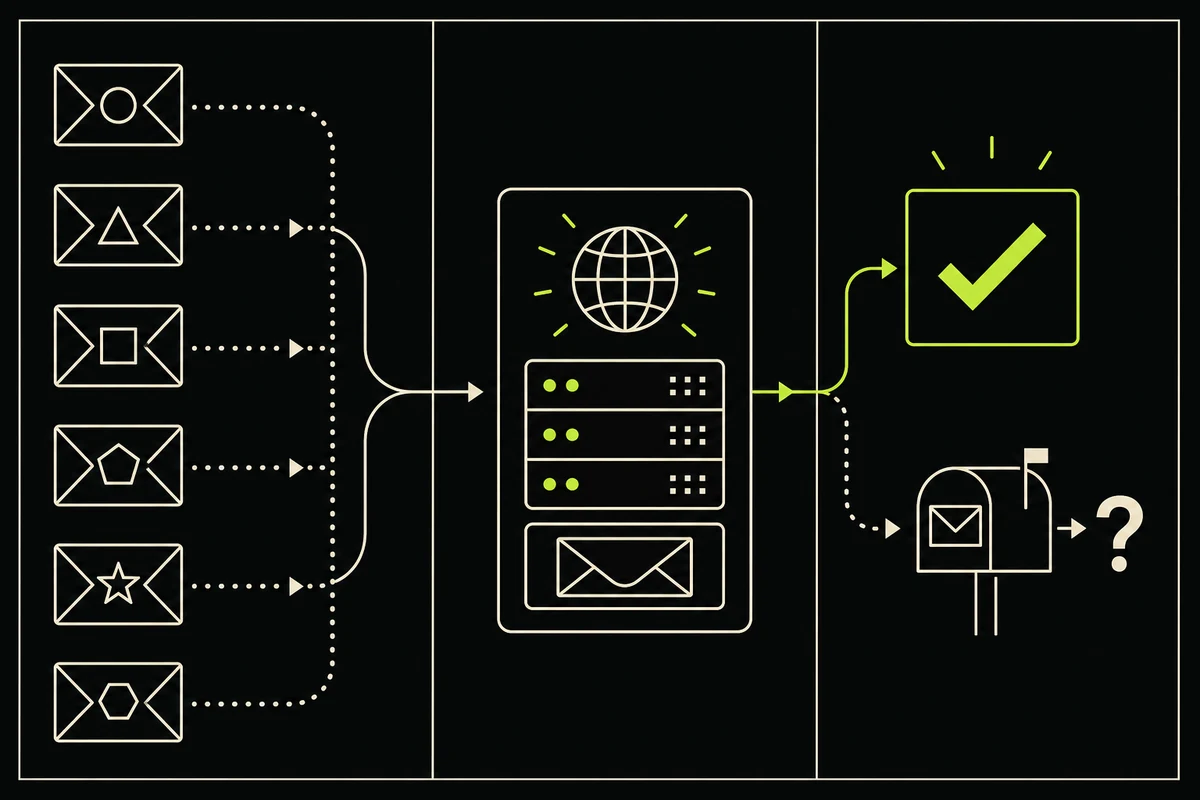
A catch-all email domain accepts mail for addresses that were never created. If the server accepts both maya@team.example and a random address at the same domain, an SMTP check cannot prove that Maya’s mailbox exists.
That does not make the address bad. It makes the mailbox result uncertain.
The safest default is to keep the domain-level fact and the mailbox-level uncertainty as separate fields. Allow or review the account according to its risk, and use email confirmation when actual inbox access matters.
What is a catch-all email domain?
A catch-all, also called accept-all, is mail-routing behavior for otherwise unmatched recipients. A domain might route every unknown local part to one mailbox, forward it to a help desk, quarantine it, or accept the SMTP transaction and make a later delivery decision.
The important bit is observable from outside: the receiving server does not reject an unrecognized recipient during the probe.
| What the probe observes | What it supports | What stays unknown |
|---|---|---|
| The target address is accepted | The server accepted that recipient during this SMTP session | Whether a person reads the mailbox or a later system discards the message |
| A random address is also accepted | The domain behaves like a catch-all | Whether the target local part names a real mailbox |
| The random address is clearly rejected | The domain distinguishes recognized and unrecognized recipients | Future delivery and inbox placement |
Catch-all is a domain behavior, not an accusation about the user.
How catch-all detection works
A careful SMTP probe can compare two recipient checks without sending message content:
- Resolve the domain’s mail-routing records.
- Open a connection to a receiving server.
- Send
EHLOorHELO, then negotiate TLS when available. - Send the envelope sender with
MAIL FROM. - Ask about the submitted address with
RCPT TO. - Reset the transaction.
- Repeat
RCPT TOwith a fresh random local part at the same domain. - Compare the replies, then close the session before
DATA.
RFC 5321 defines RCPT TO as the command that identifies an individual recipient. A probe stops before the message body, so it is testing recipient acceptance rather than delivering an email.
C: MAIL FROM:<probe@emailverifier.dev>
S: 250 OK
C: RCPT TO:<maya@team.example>
S: 250 Accepted
C: RSET
S: 250 OK
C: MAIL FROM:<probe@emailverifier.dev>
S: 250 OK
C: RCPT TO:<random-7b3f...@team.example>
S: 250 Accepted
That transcript supports catch-all behavior detected. It does not support maya@team.example definitely exists.
Why one accepted recipient is not enough
An SMTP acceptance can mean several things:
- The mailbox exists and the server is willing to receive mail.
- The domain accepts every local part.
- The server hides recipient validity to reduce directory harvesting.
- The server accepts first and rejects, quarantines, or drops later.
- A forwarding or filtering layer will make the final decision elsewhere.
There is also a timing problem. A 4yz reply is temporary by definition; the same command may succeed later. RFC 6647 describes RCPT-stage greylisting, where an unfamiliar tuple receives a temporary reply until it is old enough or retried. A temporary deferral is not evidence of a missing mailbox and it is not evidence of catch-all behavior.
The full reply-handling model is explained in How SMTP Email Verification Works.
How emailverifier.dev represents a catch-all
When the target recipient is accepted and the random control is also accepted, emailverifier.dev preserves both facts. An illustrative response looks like this:
{
  "email": "maya@team.example",
  "status": "deliverable",
  "action": "review",
  "flagged": false,
  "signals": [
    "mailbox_accepts_mail",
    "catch_all_domain"
  ],
  "suggestion": null
}
deliverable means the server accepted the recipient probe. review and catch_all_domain keep the mailbox-existence boundary visible. The result is not converted into a hard failure, and it is not flattened into an unconditional allow.
If the server defers, blocks, times out, or gives an ambiguous reply, the result should remain unknown. “The probe could not tell” is different from “the domain accepts everything.”
Use account risk to choose the next step
The catch-all signal becomes useful when it meets product context:
| Flow | Cost of being wrong | Sensible handling |
|---|---|---|
| Newsletter or waitlist | Low | Accept into a pending state and confirm before treating the address as active. |
| Ordinary product account | Moderate | Allow signup, but keep email-dependent features pending until confirmation. |
| Costly free trial or promotional credit | Higher | Require confirmation or combine the signal with rate, device, payment, and behavior controls. |
| Password reset or security alert | High | Use an established, confirmed address and the appropriate authentication checks. Catch-all detection does not prove control. |
| B2B lead form | Contextual | Route for review rather than rejecting a potentially legitimate company domain. |
This avoids two bad extremes: blocking every catch-all address and pretending every accepted recipient is a confirmed mailbox.
Do not merge unrelated signals
A catch-all address may also be role-based, but the two signals are independent. A domain can accept every recipient while the submitted local part is personal. A role address such as support@ can exist on a domain that rejects unknown recipients.
The same separation applies to disposable and free providers:
- Catch-all describes recipient acceptance behavior.
- Disposable describes a provider designed for temporary inbox use.
- Free provider describes a consumer mailbox service.
- Role-based describes a local part commonly shared by a function or team.
Combining all four into one “risky email” boolean removes the reason your product needs to make a decision. The disposable-address policy guide covers that signal separately.
Store the evidence, not a permanent verdict
A useful record can stay small:
{
  "verification_status": "deliverable",
  "verification_action": "review",
  "catch_all": true,
  "control_confirmed": false,
  "checked_at": "2026-08-13T00:00:00Z"
}
The timestamp matters because domain configuration can change. Recheck when the address is used for a high-value action or when an old result no longer represents the current routing state. Do not treat one observation as a lifetime property of the person.
Keep catch-all out of the wrong buckets
- Calling every accepted recipient “valid” without a random control.
- Calling every timeout, policy block, or temporary reply “catch-all.”
- Rejecting a company account only because its domain uses catch-all routing.
- Using catch-all as proof of fraud, identity, or mailbox ownership.
- Keeping the result forever without its check time.
Catch-all detection gives you one useful fact: the receiving domain did not distinguish the submitted local part from a random one during the check.
Keep that fact. Keep the uncertainty too.
See the broader email verification model, then use the REST API reference to add the result to your signup flow.