
Disposable Email Addresses: A Signup Policy That Fits the Risk
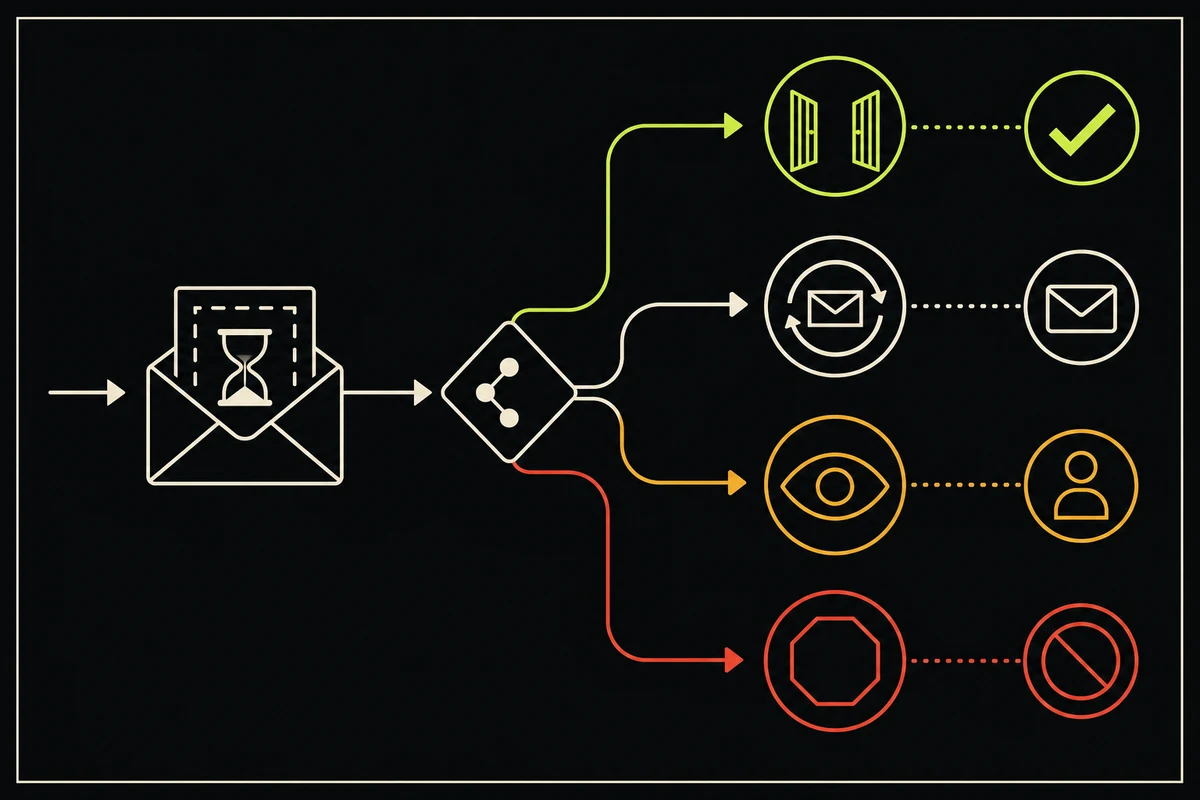
A disposable email address is a risk signal, not proof of abuse.
Block it when your flow gives away something costly, depends on a durable recovery address, or has a clear one-person-per-benefit rule. For a low-cost newsletter or waitlist, confirmation may be enough.
The policy should follow the consequence. “Disposable equals bad user” is not a policy; it is a shortcut with a false-positive budget nobody wrote down.
What counts as a disposable email address?
A disposable provider offers inboxes intended for short-term use. Some addresses last minutes, some last longer, and some can be revisited. The operational concern is the same: the address may be easy to replace and unreliable as a long-term identifier.
That is different from the other signals commonly found during email verification:
| Signal | What it describes | What it does not prove |
|---|---|---|
| Disposable provider | The domain is associated with temporary inbox use. | That this signup is fraudulent. |
| Free provider | The domain belongs to a mainstream consumer mailbox service. | That the address is temporary or low quality. |
| Role address | The local part, such as support@, may represent a team or function. |
That the mailbox cannot receive mail. |
| Catch-all domain | The receiving server accepts unrecognized local parts. | That the submitted address is disposable. |
| Mailbox rejection | The server explicitly rejected the recipient as missing or invalid. | Anything about the person’s intent. |
If your data model reduces these to one is_bad_email flag, the application loses the reason it needs to choose a proportionate response.
Write the threat model before the block rule
Disposable addresses can help someone repeat a benefit tied only to an email address. They can also leave an account without a durable recovery channel. Those are concrete product risks.
Ask four questions:
- What does the user receive? A newsletter subscription and a costly infrastructure credit do not carry the same loss.
- Does the account depend on email later? Password recovery, receipts, security alerts, and legal notices need a reachable address.
- What other controls exist? Payment, device, IP, rate, organization, and behavior signals may already carry more context.
- What does a false positive cost? Blocking a privacy-conscious reader is different from delaying an expensive trial until confirmation.
The OWASP guidance on temporary email abuse recommends maintaining a known-domain list when appropriate, preferring risk-based controls over strict blocking, and monitoring suspicious account-creation patterns.
A signup policy matrix
| Flow | Primary concern | Starting policy |
|---|---|---|
| Newsletter or content download | List quality and successful delivery | Allow into a pending state; activate after confirmation. |
| Waitlist | Duplicate entries and future contact | Allow with confirmation and rate limits. Deduplicate by more than raw email when fairness matters. |
| Ordinary product account | Recovery and notifications | Allow limited access, but require a confirmed address before email-dependent or sensitive features. |
| Costly free trial, credits, or referral reward | Repeated benefit claims | Block known disposable providers or require stronger proof before granting the benefit. |
| Paid checkout | Receipts, support, and account recovery | Use payment and fraud controls as primary context; require a reachable address without treating disposable status alone as payment fraud. |
| B2B demo or sales form | Routing and qualification | Ask for a work address when that requirement is real. Do not confuse a free provider with a disposable provider. |
The matrix is a starting point. A product with regulated notices, healthcare information, or financial access needs qualified security and legal review for its identity and communication requirements.
Use the API signal without hiding the reason
For a known disposable provider, emailverifier.dev returns risky with a default block action and the disposable_address signal. An illustrative accepted-mailbox result could look like this:
{
  "email": "trial@temporary.example",
  "status": "risky",
  "action": "block",
  "flagged": true,
  "signals": [
    "disposable_address",
    "mailbox_accepts_mail"
  ],
  "suggestion": null
}
The domain above is illustrative. The important part is the separation: the mailbox can accept mail while the provider classification still triggers a product-risk rule.
Use the result in this order:
- Block confirmed failures such as invalid syntax or unusable routing.
- Show a correction for
possible_typo. - Apply the flow-specific rule for
disposable_address. - Keep
unknownandcatch_all_domainout of the confirmed-failure bucket. - Require confirmation when inbox control is the actual requirement.
The production API result guide shows how to keep transport failures and address decisions separate.
Free email is not disposable email
A consumer mailbox can be exactly the right identity for a consumer product. Blocking every free provider often rejects legitimate users without stopping determined abuse.
If the product truly requires an organization address, state that requirement in the form. Then validate it as an eligibility rule, not as a claim that consumer inboxes are invalid.
The emailverifier.dev domain reports distinguish disposable services, free mailbox providers, and other domains. That classification lets the application make a visible rule instead of guessing from brand familiarity.
Confirmation solves a different problem
Provider classification describes the domain. Email confirmation shows that someone with access to the inbox completed a token or code flow.
A disposable address can pass confirmation. That proves current access, but it does not make the address durable. A non-disposable address can fail confirmation because of a typo, filtering, delay, or loss of access.
Store the states separately:
{
  "provider_type": "disposable",
  "verification_status": "risky",
  "control_status": "confirmed",
  "benefit_status": "withheld",
  "checked_at": "2026-08-13T00:00:00Z"
}
This record says exactly what happened. It does not force “confirmed” to erase “disposable,” or vice versa. See Email Validation vs Verification vs Confirmation for the complete state model.
Keep the domain list current
Disposable services appear, disappear, rotate domains, and use subdomains. A list copied into an application once will age.
- Normalize domains consistently before lookup.
- Update the source on a regular operational schedule.
- Track the update time and source version.
- Test known matches, subdomains, free providers, and ordinary company domains.
- Fail safely when the list cannot load; do not convert an internal error into a claim about the user.
A domain-list match should be explainable. Keep the matched classification and rule version in restricted diagnostics so support can understand why a benefit was withheld.
Measure whether the rule works
Monitor outcomes by policy branch, not by anecdotes:
- Confirmation completion rate
- Repeated benefit attempts
- Manual-review outcomes
- Support appeals and false positives
- Downstream bounces
- Transport failures from the verification dependency
Do not log full email addresses or tokens merely to build these metrics. Mask or pseudonymize identifiers and restrict access.
If the disposable rule blocks many legitimate users without reducing the behavior it targets, change the rule. The label exists to help the product decide; the product does not exist to defend the label.
Test the policy at its failure points
- Blocking mainstream free providers as if they were temporary inboxes.
- Treating disposable status as proof of fraud.
- Granting an expensive benefit immediately, then sending confirmation afterward.
- Applying one strict rule to newsletters, trials, purchases, and recovery.
- Using a stale list with no version or update process.
- Exposing the verification API key in client-side code.
A good disposable-address policy names the protected resource, the evidence required, and the cost of a false positive.
Start with the broader email verification model, browse the current disposable domain directory, or create a project to test the policy against your own flow.