
Email Subdomain Strategy: Separate Transactional and Marketing Mail
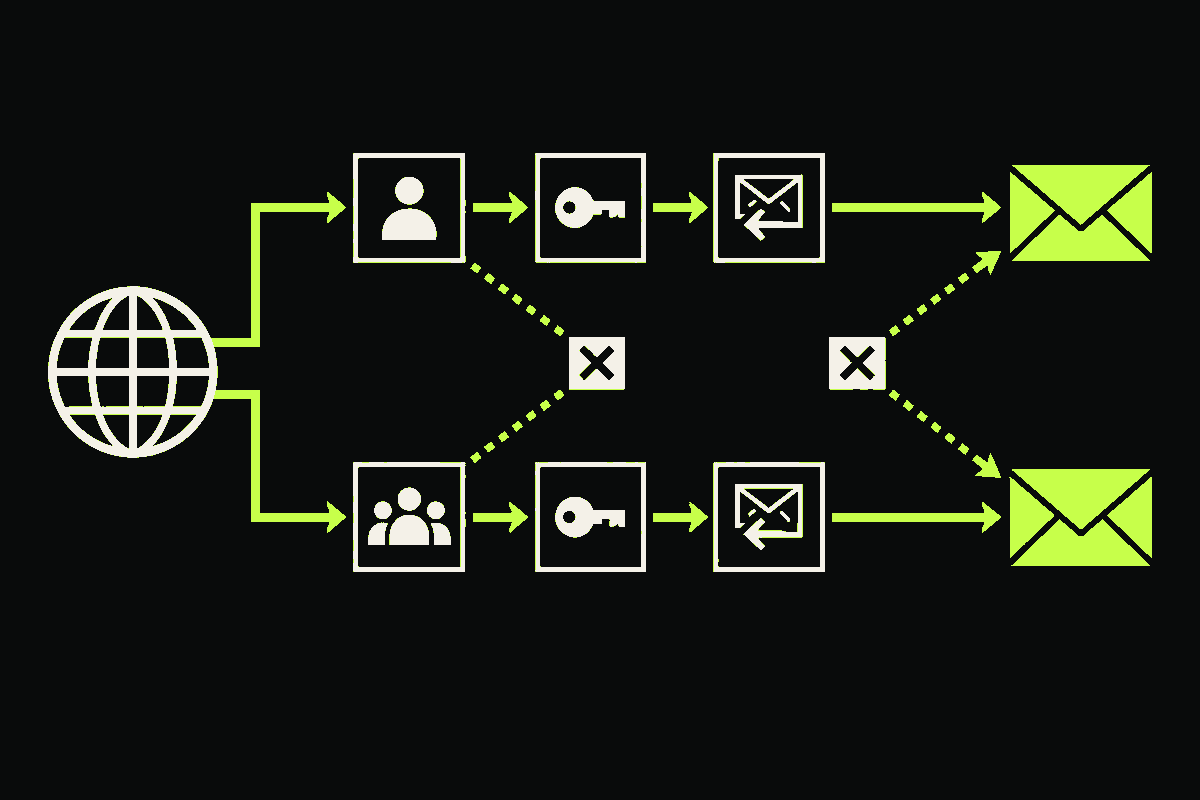
Use email subdomains when transactional and marketing mail need separate sender identities, authentication settings, reporting, or operational ownership. Keep them under the domain people already recognize, give each stream one clear purpose, and authenticate each stream independently.
A subdomain is a control boundary, not a reputation reset button. It can make a failure easier to contain and diagnose. It cannot make unwanted mail wanted, turn a shared IP into a dedicated one, or guarantee inbox placement.
I would usually start a SaaS product with a map like this:
| Mail stream | Visible From | DKIM d= |
SMTP MAIL FROM | Owner |
|---|---|---|---|---|
| Account and security | security@notify.example.com |
notify.example.com |
notify.example.com |
Identity team |
| Receipts and product events | receipts@notify.example.com |
notify.example.com |
notify.example.com |
Product platform |
| Newsletters and promotions | updates@news.example.com |
news.example.com |
news.example.com |
Lifecycle marketing |
Those are hypothetical addresses, but the separation is deliberate. A password reset should not share an identity boundary with a flash sale. M3AAWG's Sender Best Common Practices recommends relevant subdomains for different mail purposes and specifically contrasts marketing and transactional traffic.
Choose the identity boundary before you edit DNS
There are two reasonable ways to introduce subdomains. They look similar in a vendor dashboard, but DMARC evaluates them differently.
Model A: keep the root domain visible
You can keep example.com in the visible From address and use purpose-specific subdomains behind it.
From: Example Billing <billing@example.com>
Return-Path: <b+7fa2@txn.example.com>
DKIM-Signature: v=1; d=txn.example.com; s=mail2026; ...
Assuming SPF and DKIM themselves pass, both authenticated identifiers align with example.com under DMARC's default relaxed mode because they share the same Organizational Domain. They do not align under strict mode because txn.example.com is not identical to example.com.
This model keeps the familiar root domain in the inbox. The tradeoff is that the visible From domain remains shared across streams, so your reporting and policy boundaries are less explicit.
Model B: put the purpose in the visible From domain
From: Example Billing <billing@notify.example.com>
Return-Path: <b+7fa2@notify.example.com>
DKIM-Signature: v=1; d=notify.example.com; s=mail2026; ...
Here, DKIM and SPF can align strictly because the authenticated domains are identical to the visible From domain. You can also publish a DMARC record specifically at _dmarc.notify.example.com and collect reports for that identity.
RFC 9989 defines relaxed alignment as sharing an Organizational Domain and strict alignment as exact equality. It also says relaxed alignment is sufficient for nearly all domain owners. So I would not choose strict alignment just because it sounds stronger. I would choose the identity model first, then set adkim and aspf to match the model I can actually operate.
What should be separate?
A useful subdomain plan separates more than the address after the @. I want each stream to have an inspectable chain of responsibility:
- Visible identity: a From domain that truthfully describes the sender.
- Authentication: DKIM selectors and an SPF-authorized MAIL FROM domain controlled for that stream.
- Feedback: DMARC aggregate reports, bounce events, complaints, and unsubscribes routed to the correct owner.
- Change control: named people who can approve a new sender, rotate a DKIM key, or stop traffic.
This is why merely adding mail. to every vendor setting is not a strategy. If marketing and transactional systems still share keys, return paths, reports, and escalation ownership, the new label has not created much separation.
It is also why I avoid lookalike “cousin” domains such as example-mail.com. A related subdomain is easier for a recipient to connect to the organization, and M3AAWG explicitly recommends subdomains instead of cousin domains when a business needs differentiation. Gmail's sender guidelines likewise require clear, non-misleading sender information and accurate headers. Separation should clarify identity, not disguise it.
Does a subdomain protect transactional delivery?
It helps you control and observe the stream. It does not create a firewall that mailbox providers must honor.
A provider can evaluate the sending IP, DKIM domain, From domain, organizational domain, content, complaints, recipient engagement, and sending history together. Some signals are stream-specific and some can roll up. That is why the honest promise is smaller operational blast radius, not immunity.
Suppose a promotion produces a complaint spike. With a distinct news.example.com identity, I can identify the affected source in DMARC aggregate reports, pause that program, and keep its keys and configuration out of the account-mail path. That makes diagnosis and response cleaner. It does not force a receiver to ignore the relationship between news.example.com and notify.example.com.
The strongest fair objection is that several subdomains create more DNS and vendor configuration to maintain. They do. For a tiny product sending only password resets and invoices, one authenticated transactional identity may be enough. I add a second boundary when the purpose, audience, owner, consent model, or volume pattern is genuinely different.
Migrate without breaking DMARC alignment
I would not switch the From domain, return path, DKIM domain, and DMARC enforcement policy in one release. That turns four observable changes into one opaque failure.
Instead, I use four checkpoints.
1. Inventory the current message identities
Capture one real header from every sending system. Record the visible From domain, Reply-To, Return-Path, DKIM d= and s=, sending IP, and current DMARC result. The From, Reply-To, and Return-Path guide shows where each identity enters the delivery path.
2. Create the authentication lane
Provision the new DKIM selector and MAIL FROM domain. Verify the published records before moving production traffic. A hypothetical subdomain policy might begin as:
_dmarc.notify.example.com. 3600 IN TXT (
  "v=DMARC1; p=none; rua=mailto:dmarc@reports.example.com"
)
An explicit record on the From subdomain gives that identity its own reporting and policy point. If you do not publish one there, the applicable organizational policy may be discovered through DMARC's DNS tree walk. Also check the parent record's sp and np behavior before assuming what happens to other subdomains. RFC 9989 section 4.7 defines those policy and alignment tags.
3. Move a controlled slice and inspect received headers
Send to mailboxes you control at several providers. Confirm the received message has the expected From, Return-Path, DKIM signing domain, and an aligned DMARC pass. DNS configuration is intent. The received header is evidence of what the system actually emitted.
If DKIM passes but DMARC fails, compare the d= domain with the visible From domain. If SPF passes but DMARC fails, compare the MAIL FROM domain instead. The distinction is worked through in our SPF, DKIM, and DMARC trace.
4. Watch reports before tightening policy
Run long enough to see normal billing cycles, deployments, and low-frequency senders. Classify every authorized source in the aggregate data. Only then decide whether the subdomain is ready for a stronger policy.
Do not treat p=none as a permanent success state, but do not jump to rejection while an unaligned sender is still unexplained. A clean migration has an owner for every source and an explicit decision for every exception.
My default boundary for a SaaS product
I separate mail when failure would require a different response.
Security alerts, sign-in links, password resets, and critical account notices belong on a tightly controlled transactional identity. Receipts and routine product events can share that identity when the same team and infrastructure own them. Newsletters, lifecycle campaigns, and promotions belong on a marketing identity with their own consent, unsubscribe, volume, and complaint controls.
I do not create a new subdomain for every template or product feature. That fragments the system without creating a useful boundary. Two or three durable streams are easier to explain, monitor, and secure than a taxonomy of forgotten DNS records.
Finally, keep the claims narrow. Authentication shows that a domain owner authorized the domain used in a message. It does not prove the message is safe, wanted, or destined for the inbox. An email subdomain strategy works when it makes those authorization and ownership boundaries visible to both machines and the people operating them.