
SMTP Connection Pooling: Reuse Sessions Without Duplicate Sends
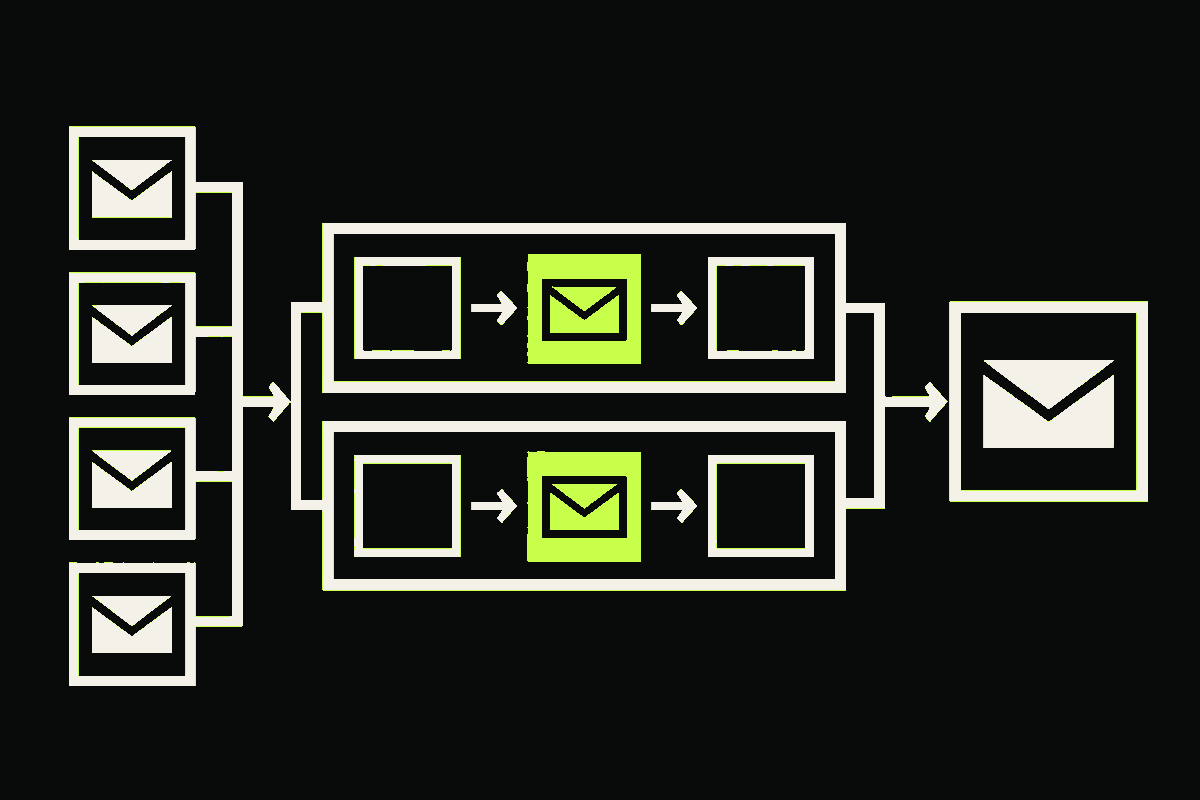
SMTP connection pooling means keeping a small, bounded set of authenticated SMTP sessions open and reusing each one for multiple mail transactions. It can remove repeated TCP, TLS, and authentication setup from your send path. It does not make delivery certain, turn a failed send into a safe retry, or let you ignore your provider’s connection limits.
I use one rule to keep the design honest: reuse connections, but track acceptance per message. The socket is an optimization. The SMTP reply is evidence.
One connection can carry several separate messages
The easiest way to understand a pool is to separate an SMTP session from a mail transaction. A session begins when the client connects and ends when it quits or the connection fails. Inside that session, each message gets its own transaction.
S: 220 submission.example.net ready
C: EHLO app.example.com
C: AUTH ...

C: MAIL FROM:<receipts@example.com>
C: RCPT TO:<alice@example.net>
C: DATA
C: ...message A...
C: .
S: 250 queued as A17

C: MAIL FROM:<receipts@example.com>
C: RCPT TO:<bob@example.org>
C: DATA
C: ...message B...
C: .
S: 250 queued as B24

C: QUIT
S: 221 closing connection
This is a simplified, hypothetical transcript. The important boundary is the final 250 after the end-of-data marker. RFC 5321 says that a successful reply there means the receiving SMTP server has accepted responsibility for the message. It does not mean the destination inbox received it.
The next MAIL FROM starts fresh transaction state on the same connection. If a transaction must be abandoned, RSET clears its sender, recipients, and message data without closing the session. Use a client library to handle this protocol state. Pooling should not require application code to write raw SMTP commands.
What state should the pool own?
A production pool is not just an array of sockets. I find this state model more useful because it ties each connection state to the next safe application action:
| Pool or connection state | What it means | Safe application action |
|---|---|---|
| Connecting | TCP, TLS, and authentication are still in progress. | Keep work in the external queue. |
| Idle | The session can begin a new mail transaction. | Lease one queued message. |
| Busy | One transaction is active on this connection. | Do not interleave another message unless the library explicitly supports it. |
| Draining | No new work is accepted, but active transactions may finish. | Wait for in-flight sends before shutdown. |
| Broken or closed | The session cannot be reused. | Classify the affected message by its last confirmed SMTP stage before deciding what happens next. |
That last row is where most operational mistakes happen. “The connection dropped” is not enough information. A drop before any message command is different from a drop after the client sent the final dot but before it received the server’s reply.
A bounded Node.js pool
Nodemailer exposes pooled SMTP directly. Create one transporter for the process, set an explicit connection ceiling, and feed it from your durable queue only when it has capacity. The queue methods in this example are placeholders for your own durable queue interface.
import nodemailer from "nodemailer";

const transporter = nodemailer.createTransport({
  host: process.env.SMTP_HOST,
  port: 465,
  secure: true,
  pool: true,
  maxConnections: Number(process.env.SMTP_POOL_CONNECTIONS ?? 3),
  maxMessages: Number(process.env.SMTP_POOL_MAX_MESSAGES ?? 50),
  auth: {
    user: process.env.SMTP_USER,
    pass: process.env.SMTP_PASS,
  },
});

let draining = false;

transporter.on("idle", async () => {
  while (!draining && transporter.isIdle()) {
    const job = await mailQueue.leaseNext();
    if (!job) return;

    transporter.sendMail(job.message)
      .then((info) => mailQueue.markAccepted(job.id, {
        accepted: info.accepted,
        rejected: info.rejected,
        response: info.response,
      }))
      .catch((error) => mailQueue.markAttemptFailed(job.id, error));
  }
});

process.on("SIGTERM", async () => {
  draining = true;
  stopLeasingNewJobs();

  while (transporter.transporter.pendingCount() > 0) {
    await new Promise((resolve) => setTimeout(resolve, 250));
  }

  transporter.close();
});
The values 3 and 50 are example starting points, not recommendations. Nodemailer’s current defaults are five simultaneous connections and 100 messages per connection, but your provider’s documented limits and your own acceptance latency should determine the real settings. The pooled SMTP documentation also exposes maxRequeues, idleTimeout, and a pool-wide rate limit.
Two details matter in this pattern. First, the queue is upstream of the pool. I do not load thousands of messages into process memory and hope the sockets keep up. Second, shutdown stops new leases before closing the pool. Nodemailer rejects messages still waiting in its internal queue when close() is called, so “call close and exit” is not a drain strategy. Your process manager also needs a termination grace period longer than the drain deadline.
How many connections should you open?
Start with the smallest pool that meets your required send rate. A useful approximation is:
needed connections ≈ target accepted messages per second × average SMTP transaction seconds
If your target is 10 accepted messages per second and one transaction takes 0.2 seconds on average, the rough concurrency requirement is two. That example is hypothetical. Measure your own acceptance latency, and cap the result at the lower of:
- your SMTP provider’s simultaneous-connection limit,
- your provider’s message-rate limit, and
- the concurrency your worker can observe and drain safely.
More connections are not automatically faster. A larger pool can increase throttling, spread failures across more in-flight work, and make shutdown less predictable. If one connection is always idle, the pool is already large enough for the current load.
When is a retry safe?
Pooling and retrying solve different problems. The pool decides which healthy session carries a transaction. Your delivery workflow decides whether another attempt is warranted.
Before the server accepts the message, retry may be appropriate according to the SMTP reply and your SMTP retry policy. After a final 250, record the message as accepted by that server. Do not send it again just because a later webhook is slow.
The uncomfortable case is a connection loss after the client sent the end-of-data marker but before it received the reply. The server may have accepted the message even though the client never saw the confirmation. Retrying blindly can create a duplicate. Keep that attempt in an acceptance unknown state and reconcile it using a stable message identifier, provider evidence, or an operator policy. The duplicate-email guide owns that recovery design.
You may reasonably ask: why not open a fresh connection for every message and avoid all this state? That is simpler at very low volume. It also repeats TCP, TLS, and authentication work, and it can collide with connection-rate limits. Pooling becomes useful when setup is a meaningful share of send time or when your provider expects bounded reuse. The goal is not maximum socket lifetime. It is predictable, observable concurrency.
Connection pooling is not SMTP PIPELINING
The names are easy to mix up. Pooling reuses a connection across multiple messages. SMTP PIPELINING can send groups of commands without waiting for each individual reply, but only when the server advertises PIPELINING in its EHLO response. RFC 2920 defines that extension.
Let your SMTP library negotiate command pipelining. Your application-level decision is whether to reuse a bounded set of sessions and how to preserve message state around them.
What should you monitor?
I would ship a pool with five measurements:
- open, busy, and idle connection counts,
- messages waiting outside the pool,
- SMTP transaction latency from
MAIL FROMto the final reply, - reconnects and requeues by failure stage, and
- accepted, rejected, temporary-failure, and acceptance-unknown outcomes.
Keep transport acceptance separate from delivery events. If you need the boundary refresher, see sent vs delivered. Also keep credential refresh separate from connection reuse; the SMTP OAuth 2.0 guide covers token lifecycle.
Recipient screening belongs before the queue. EmailVerifier.dev can help you classify address evidence and preserve inconclusive results instead of forcing them into “valid” or “invalid.” It does not manage SMTP sessions, prove inbox ownership, prevent duplicate sends, or guarantee delivery.
A safe SMTP pool is deliberately boring: one shared transporter, a bounded connection count, one transaction at a time per connection, explicit acceptance states, and a shutdown path that drains before it closes. You gain the benefit of reuse without turning a socket optimization into a delivery-state bug.