
Is Email Encrypted? What TLS Protects and What It Does Not
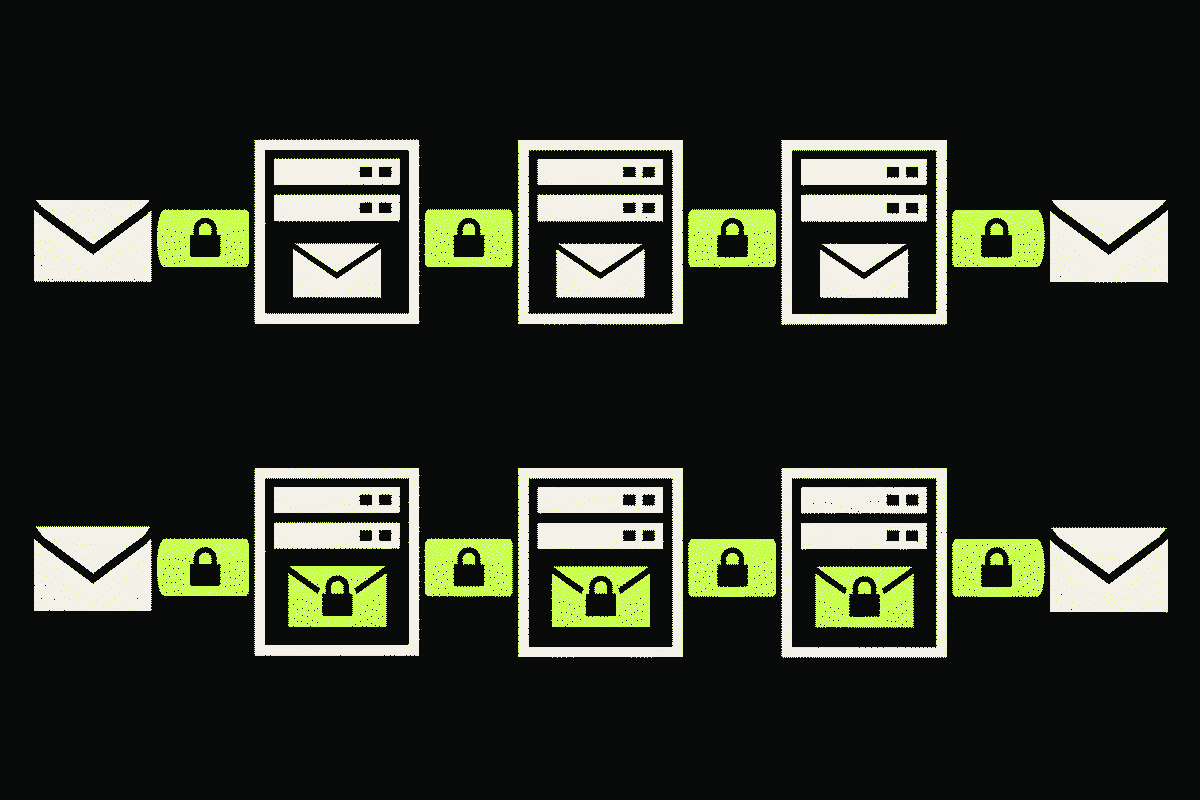
Email is often encrypted while it moves, but ordinary email is usually not end-to-end encrypted. TLS can protect a connection between two systems. The sending application, submission server, relay servers, receiving provider, and recipient device are separate boundaries, and the message may be readable at several of them.
I treat “encrypted email” as an incomplete statement until it names the hop, the data being protected, and who holds the keys. That distinction tells you whether you are stopping network eavesdropping, a downgrade attack, or a mail provider from reading stored content.
One message crosses five encryption boundaries
A typical message is composed in an application, submitted to a mail server, relayed to the recipient’s provider, stored in a mailbox, and fetched by a client. Encryption can start and stop at every boundary.
| Boundary | What TLS protects | Who may still read the message |
|---|---|---|
| App to submission server | The network connection | The app and submission server |
| Mail server to mail server | One relay hop at a time | Each server handling that hop |
| Receiving provider storage | Nothing by itself | The provider, unless a separate control applies |
| Mailbox to recipient client | The access connection | The provider and recipient client |
| End-to-end protected content | The encrypted message payload across every hop | Endpoints holding the decryption keys |
This is the useful mental model: transport encryption protects a pipe. End-to-end encryption protects the message inside the pipes.
Why is STARTTLS useful but not end-to-end?
RFC 3207 defines the SMTP STARTTLS extension. A server advertises the capability, the client requests TLS, and the two peers negotiate an encrypted connection before the SMTP conversation continues.
That stops passive observers on that network path from reading the SMTP session. It can also authenticate the server when certificate validation is performed correctly. For application submission and mailbox access, RFC 8314 recommends TLS rather than cleartext connections.
But RFC 3207 is explicit that SMTP is not an end-to-end mechanism. A message can pass through more than two SMTP servers. TLS on one connection says nothing about the next connection, and each receiving server terminates TLS before processing or relaying the message.
STARTTLS also begins as a capability announced over cleartext SMTP. Without a policy that requires TLS, an active attacker may try to remove that announcement and cause a downgrade. The SMTP ports guide explains where implicit TLS and STARTTLS normally appear in submission and relay traffic. Port choice alone does not make the whole route end-to-end secure.
What changes when a domain enforces transport encryption?
Opportunistic TLS means “use TLS when both sides can.” Enforcement adds a rule for what the sender should do when secure transport is unavailable or the destination cannot be authenticated.
MTA-STS lets a receiving domain publish its authorized MX hosts and require supporting senders to use certificate-validated TLS. DANE for SMTP uses DNSSEC-protected TLSA records to authenticate the destination and resist downgrades. These are different policy systems, but both try to turn a best-effort relay hop into an authenticated, encrypted one.
That is worth deploying. It protects server-to-server traffic from classes of interception and downgrade attacks. Our MTA-STS and TLS-RPT walkthrough covers the DNS, HTTPS policy, rollout state, and reporting path.
What does not change? The sending and receiving mail systems still process the message. MTA-STS and DANE do not encrypt a mailbox database, hide content from a provider, or make the sender trustworthy. Authentication and encryption are separate questions, as the SMTP AUTH, SPF, DKIM, and DMARC comparison shows.
What changes with end-to-end encryption?
End-to-end email encryption happens before the message enters the relay system and is removed only by an intended recipient’s client. The mail servers carry an encrypted MIME object instead of the readable message body.
S/MIME 4.0 defines encryption and digital signatures for MIME data. PGP/MIME is another standardized approach. The IETF’s 2025 guidance on end-to-end email security treats both as ways to provide confidentiality, integrity, and authentication for message content.
The improvement comes with a new operational requirement: key management becomes part of email delivery. The sender needs a valid encryption key for every recipient. Recipients need to retain their private keys. Multiple devices must agree on identity and key state. Lost keys can make old mail unreadable, while copied keys weaken the boundary you were trying to create.
Headers need careful treatment too. Legacy clients may encrypt the body while leaving the subject and other user-facing fields exposed. Even with modern header protection, routing metadata must remain available for the mail system to deliver the message. End-to-end encryption protects content, not the fact that two addresses exchanged mail at a particular time.
If every hop uses TLS, what is left to protect?
The strongest fair objection is that a route with TLS on every hop sounds equivalent to end-to-end encryption. On the wire, it can provide strong protection. At the server boundaries, it is different.
Each hop decrypts the connection so the receiving system can inspect, filter, route, store, or forward the message. A compromise or misconfiguration at one of those systems can expose readable content. Backups, message queues, logs, and mailbox storage are separate from the TLS session. “Encrypted in transit” does not tell you how any of those copies are protected.
End-to-end encryption keeps the inner content encrypted across those systems, but it does not rescue a compromised sender or recipient device. Once an authorized client decrypts the message, malware or an account takeover at that endpoint can read it. No single lock removes every trust boundary.
Choose the control by the threat
For ordinary application email, require TLS for submission, validate the server certificate, and use the provider’s documented connection mode. If you operate a receiving domain, add an inter-domain transport policy such as MTA-STS or DANE and monitor failures. Those controls materially improve transport security without pretending the provider cannot read the message.
For content that the mail service itself must not read, transport TLS is not enough. Use an end-to-end scheme whose certificate or key distribution, recovery, device synchronization, and header behavior fit the people exchanging the mail. If those workflows cannot be supported safely, reconsider whether ordinary email should carry that content at all.
Email verification solves a different problem. It can evaluate syntax, mail routing, provider signals, and mailbox acceptance when available, but it does not encrypt a message, authenticate its author, or prove inbox ownership. Inconclusive checks should remain unknown, and a separate confirmation flow is still required when ownership matters. The production API-results guide shows how to preserve those boundaries.
So the practical answer is precise: most email can be encrypted in transit, but call it end-to-end encrypted only when the content is encrypted before it enters the mail system and only the intended endpoints hold the decryption keys.