
How Long Do MX Records Take to Update? TTL and Safe Migration
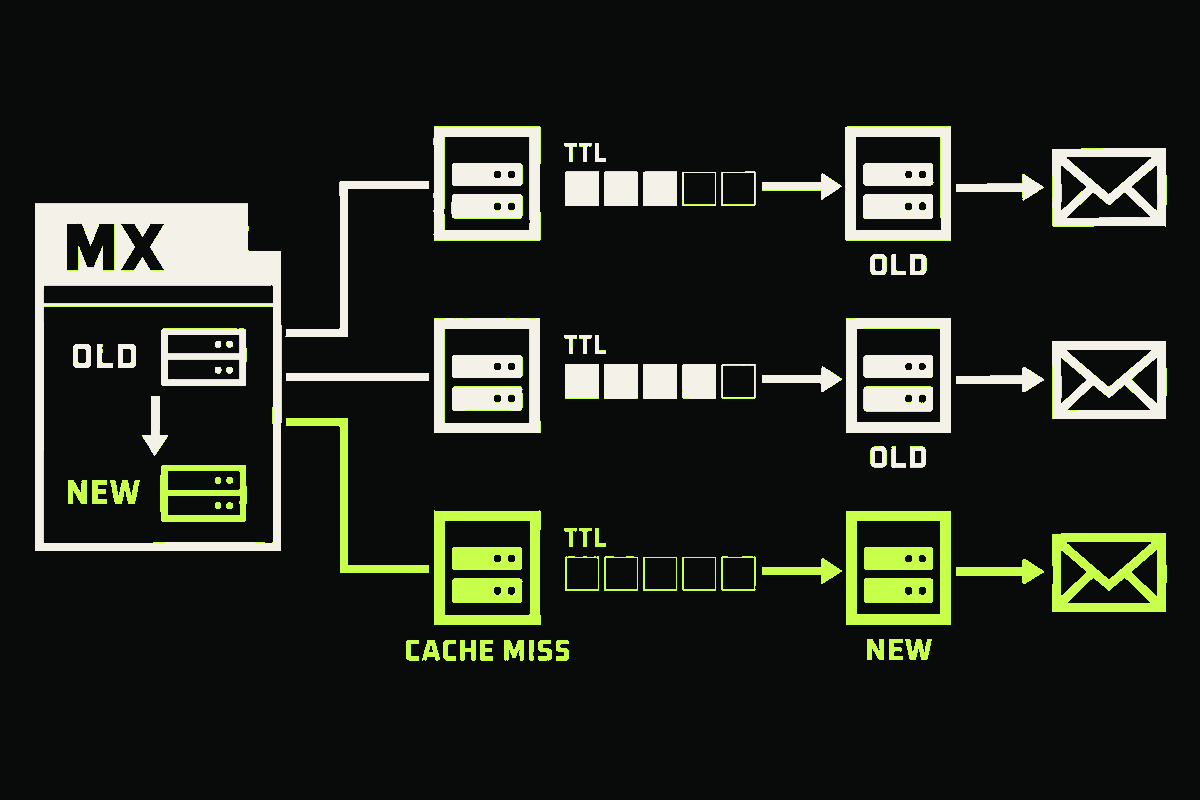
An MX record change can be visible to a sender immediately, or only after that sender's cached answer expires. There is no single global propagation timer. The useful upper bound for an ordinary planned change is the longest remaining TTL on the old MX answer, plus time for your DNS provider to publish the update. If you lower the TTL only at cutover, it is too late for resolvers already holding the old value.
That distinction matters during a mail migration. For part of the change window, different senders can legitimately route mail to different systems. I plan for that split instead of waiting for a dashboard to declare that DNS has “propagated.”
Three resolvers can see three different MX answers
Suppose example.com currently has a 3,600-second MX TTL. At 09:00, the administrator lowers it to 300 seconds. The final MX cutover happens at 10:00, after the previous 3,600-second window has elapsed.
This is a hypothetical timeline. It shows why the age of each resolver's cache matters more than a universal 24-hour estimate.
| Resolver | Cache at 10:00 | MX answer | Next refresh |
|---|---|---|---|
| A | Old MX, 3 minutes left | Old MX | 10:03 |
| B | Cache miss | New MX | Immediately |
| C | Old MX, 4 minutes left | Old MX | 10:04 |
Resolver A does not receive a broadcast when the authoritative record changes. It keeps the answer it obtained at 09:58 until that answer's TTL reaches zero. Resolver B has no old answer, so its next query can return the new MX immediately. Resolver C remains on the old route for four more minutes.
The model comes directly from DNS. RFC 1034 defines TTL as the time limit for keeping a resource record in a cache and recommends reducing it before an anticipated change. TTL is therefore a cache lifetime, not a countdown shared by every resolver.
One fair objection is that some DNS changes really do take much longer. They can. A provider may take time to update its authoritative servers, a resolver may deliberately cap or shorten TTLs, and RFC 8767 permits stale answers to be served in specific failure conditions. Those are reasons to observe the cutover, not reasons to replace the TTL model with “always wait 48 hours.”
Why lowering the TTL at cutover does not help old caches
A resolver stores the TTL that arrived with the answer it cached. Changing the authoritative TTL from 3,600 to 300 seconds does not reach backward into that cache and rewrite its remaining lifetime.
If a resolver queried one minute before you lowered the TTL, it can retain the old answer for almost another hour. The safe sequence is:
- Reduce the MX TTL.
- Wait at least one full interval of the previous TTL.
- Make the MX change.
- Expect old and new routes to coexist for roughly the new TTL, subject to provider publication time and resolver behavior.
Waiting through the previous TTL is the step that clears out most long-lived old answers. Skipping it is the usual reason a five-minute TTL still produces an hour of mixed routing.
Check the whole dependency chain too. An MX record points to a hostname, and that hostname must resolve to an address used by the SMTP client. RFC 5321 section 5.1 describes that MX-to-address lookup. A low MX TTL does not shorten a separately cached A or AAAA record. If the mail exchanger's IP address is also changing, lower and observe the address-record TTL on its own schedule.
A safe MX migration keeps both routes alive
I treat an MX cutover as an overlap, not a flip. The old receiving system remains available while senders age out cached DNS data and the new system proves that it can accept real traffic.
- Inventory the current route. Record every MX hostname, preference, TTL, and corresponding A and AAAA record. The MX priority guide explains how senders choose among multiple exchangers. Preference is routing order; TTL is cache lifetime.
- Prepare the new receiver before DNS changes. Confirm the SMTP service, certificates, recipient routing, spam controls, logging, and any transport policy that names the MX hosts. If the domain uses MTA-STS, review the cached-policy behavior in the MTA-STS and TLS-RPT deployment guide.
- Lower TTLs early. Reduce the MX TTL and any changing A or AAAA TTL. Wait through the old values before scheduling the cutover.
- Publish the new MX set. Query the authoritative nameservers directly, then compare several independent recursive resolvers. These checks answer different questions: whether the source has changed, and which cached view a sender may receive.
- Run both receiving paths. Keep the old service able to accept and forward mail during the overlap. Watch accepted messages, deferrals, rejections, TLS failures, and queue growth on both sides.
- Retire the old path last. Wait beyond the old cache window and your chosen operational margin. Confirm that traffic has drained before removing the old service, certificates, routing, or transport-policy entries.
SMTP makes DNS errors operationally important. A temporary DNS failure requires the message to be queued and retried, while an unusable MX set can become an error. Keeping the previous receiver available turns mixed DNS views into a controlled overlap rather than lost mail.
What if the domain previously had no MX record?
Adding the first explicit MX has a second cache to consider. A recursive resolver may already hold a negative answer saying that no MX data exists. RFC 2308 section 5 says negative answers have their own TTL, derived from the zone's SOA data, and must not be reused after that TTL reaches zero.
That negative TTL is separate from the TTL on the new MX record. Before adding mail service to a domain, inspect the SOA record and plan for cached NODATA or NXDOMAIN responses. The difference between no MX data, a null MX declaration, and a temporary DNS failure is covered in the null MX versus no MX guide.
The same caveat applies when an MX hostname is brand new. A resolver that previously cached “no address record” for that hostname can continue returning the negative answer until its negative TTL expires. Publish the destination's A and AAAA records before putting that hostname into the MX set.
How to verify a cutover without chasing a fake global percentage
A propagation checker can show useful samples, but “90% propagated” is not a DNS protocol state. The senders that matter may use resolvers outside the sample, and each cache can have a different remaining lifetime.
Use evidence from four places:
- Authoritative DNS: confirms the zone is publishing the intended MX, TTL, and target addresses.
- Recursive DNS: samples what common resolver paths currently return, including remaining TTLs.
- Both mail systems: proves where senders are actually connecting and whether either path is deferring or rejecting mail.
- Message headers: shows the route taken by a delivered test message. Test from more than one independent sender.
If the authoritative answer is correct but one recursive resolver still shows the old MX with a positive remaining TTL, waiting is appropriate. If its TTL repeatedly resets without the answer changing, investigate delegation, hidden provider publication delays, split-horizon DNS, or a resolver serving stale data during an authoritative outage.
The practical answer is not “MX records take 24 to 48 hours.” It is: find the old TTL, lower it before the change, wait for that old window to clear, then keep both receivers live through the new cache window and an operational margin. That gives every sender a valid route while DNS views converge.